

Supported languages
Config schemas are defined using a schema language—a formal language for describing the structure, constraints, and data types of a configuration. Miru supports:- JSON Schema (draft 2020-12)
- CUE
Validating instances
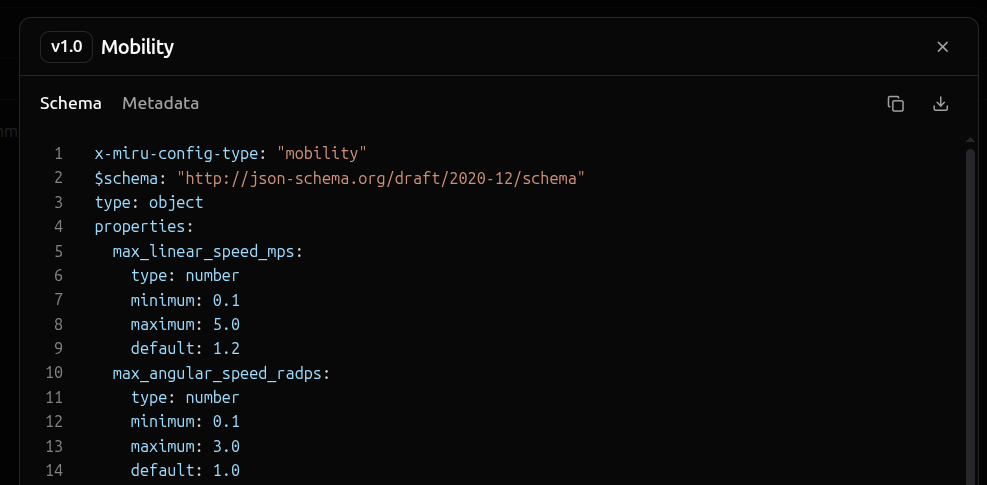
The primary purpose of schemas is to validate config instances. Let’s look at a simple example to see this in action. The following is a toy schema written in JSON Schema.JSON Schema
- Names the available properties
- Organizes the configuration structure, placing some properties at the root while nesting other properties in logical groups
- Gives each property a type, such as
number,boolean, etc. - Constrains the values of each property—minimums, maximums, enumerations, etc.
- Supplies default values to properties where appropriate
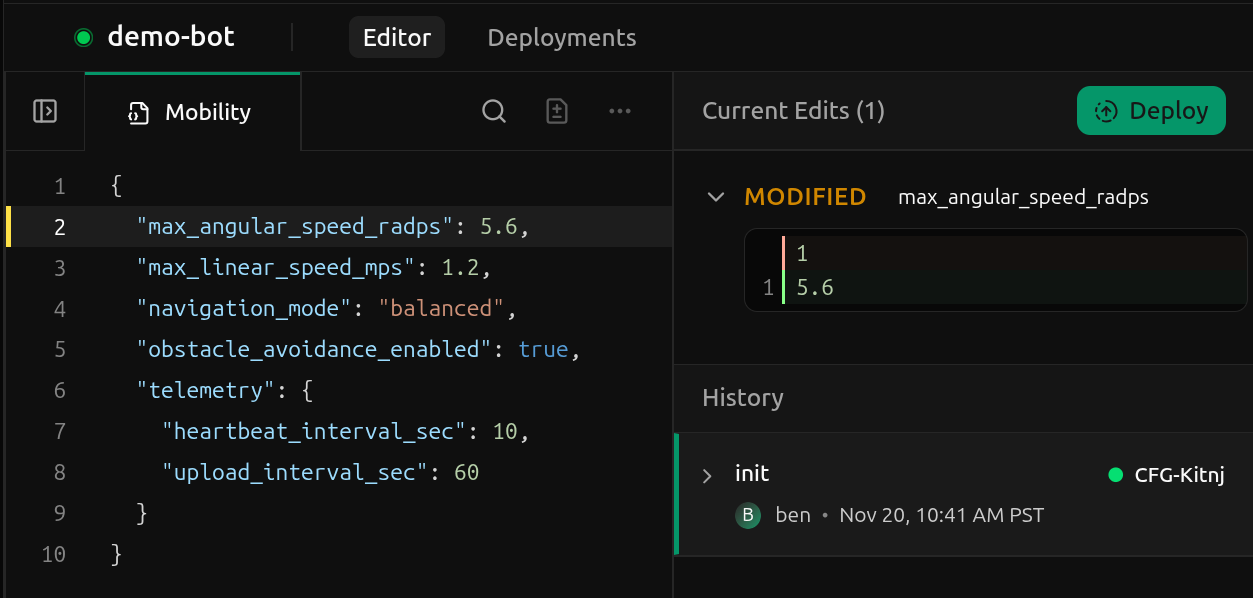
max_angular_speed_radps field exceeds the maximum allowed value of 3.0.
Luckily, before deployment to the device, the config instance is validated against the schema, throwing the following error:

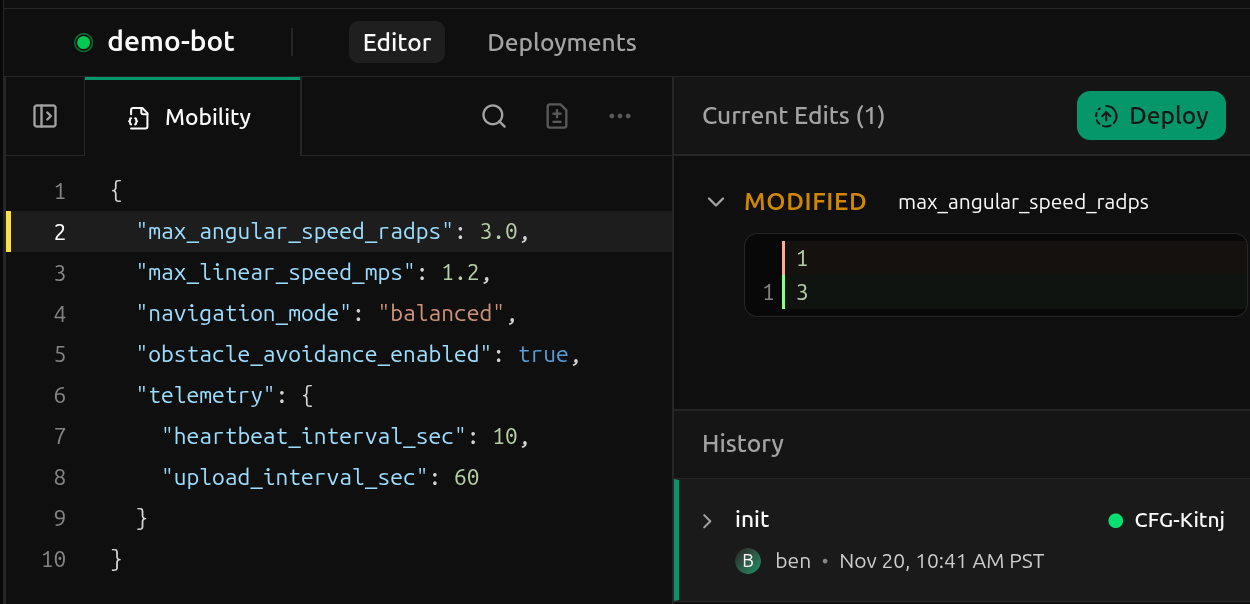
max_angular_speed_radps field to use the maximum allowed value of 3.0 and deploy the config instance to the device.
Empty schemas
While schemas can provide a lot of value for production deployments, it can be a significant undertaking to define a schema from scratch. Many teams find it best to begin with an empty schema—a schema that accepts any configuration—and gradually add constraints over time. This approach allows you to define the most high value constraints first and gradually transition to stricter and stricter schemas as needed. Below are the empty schemas for JSON Schema and CUE respectively.Properties
Config schemas leverage several properties to adequately describe their format and organize them within their config type. All properties are immutable except for theinstance_filepath property, which may be updated at anytime.
language
immutableThe schema language used to define the schema.Currently supported schema languages include:
- JSON Schema (Draft 2020-12)
- CUE
jsonschema, cueformat
immutableThe file format used to define the schema.Some languages, such as JSON Schema, support multiple formats (e.g. JSON, YAML) while others, such as CUE, only support a single format (i.e. CUE lang itself).A schema’s format does not need to match the format of the config instance it validates. Below are the supported schema and config instance formats for each schema language.
Examples:
| Language | Schema Formats | Instance Formats |
|---|---|---|
| JSON Schema | JSON, YAML | JSON |
| CUE | CUE | JSON |
Support for more config instance formats including YAML and JSON-C are coming soon.
json, yaml, cuecontent
immutableThe raw schema definition written in the specified schema language.The exact contents of a schema file is preserved in Miru including any comments, whitespace, and formatting.
digest
immutableA hash of the canonicalized schema content, useful for comparing the contents of two schemas.Digests are computed by converting a schema to it’s canonical form and hashing the result. This is useful for detecting duplicate schemas (even with changes in whitespacing, comments, etc.) and ensuring version integrity.
version
immutableA semantic version, unique for a given config type.Versions must be dot separated integers. You may optionally use a
v prefix, a prerelease suffix (e.g. -beta.1, -rc.1), and/or a build suffix (e.g. +metadata).Examples: v1, 1, v2.1, 2.1, v3.2.1, 3.2.1, v4.3.2-beta.1, 4.3.2-rc.1, v5.4.3+metadata, 6.5.4-beta.2+metadatainstance_filepath
mutableThe filepath to deploy config instances (for this schema) on a device relative to the
/srv/miru/config_instances directory.The default instance file path for a schema is {my-config-type-slug}.json, which deploys config instances to /srv/miru/config_instances/{my-config-type-slug}.json.Individual config instances may override their schema’s default file path with a custom file path at deployment time.To modify the file path deployed for all future instances of this schema, simply update the instance_filepath property.Examples: /v1/mobility.json, /config/safety.json