

Framed content
A config schema defines the structure, types, and constraints of a config instance. It serves as a contract between code and configuration, ensuring that config instances are valid before being deployment to devices.

Properties

language
string
The schema language used to define the schema.Allowed values:
  • jsonschema
  • cue
format
enum
The file format used to define the schema.Config schemas support the following file formats:
LanguageSchema FormatsInstance Formats
JSON SchemaJSON, YAMLJSON
CUECUEJSON
Note that a schema’s format does not need to match the format of the config instance it validates. For example, a YAML-formatted JSON Schema can validate a JSON-formatted config instance.Allowed values:
  • cue
  • json
  • yaml
content
string
The raw schema definition, written in the specified schema language.The exact contents of a schema file is preserved in Miru, including any comments, whitespace, and formatting.
digest
string
A hash of the canonicalized schema content.Digests are computed by converting schemas to a canonical format—a format that ignores whitespace, comments, and other non-semantic differences—and then hashing the result. This is useful for comparing schemas and detecting duplicates.Examples: sha256:45YeoJJ2btBnAKQztAEXEjHsqyyQfC1z1Mw3LLM4xMUy
instance file path
string
The instance file path is the file path to deploy config instances (for this schema) on a device, relative to the /srv/miru/config_instances directory.The default instance file path for a schema is {my-config-type-slug}.json, which deploys config instances to /srv/miru/config_instances/{my-config-type-slug}.json.Examples: /v1/mobility.json, /config/safety.json
config type
Config Type
The config type to which the schema belongs.Examples: Mobility, Safety Features, Perception

Schema languages

Config schemas are defined using a schema language—a formal language for describing the structure, constraints, and data types of a configuration. Miru supports: For more information on schema languages, visit the languages section of this guide.

File formats

Config schemas support the following file formats:
LanguageSchema FormatsInstance Formats
JSON SchemaJSON, YAMLJSON
CUECUEJSON
Note that a schema’s format does not need to match the format of the config instance it validates. For example, a YAML-formatted JSON Schema can validate a JSON-formatted config instance.

Validating instances

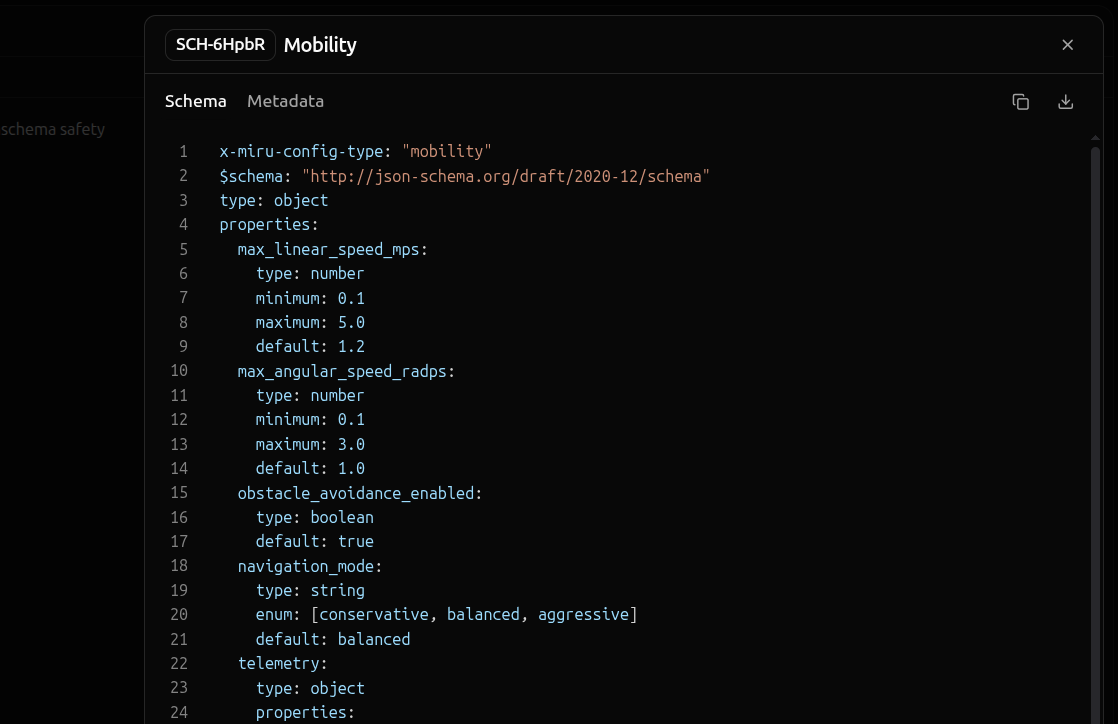
The primary purpose of schemas is to validate config instances. Let’s look at a simple example to see this in action. The following is a toy schema written in JSON Schema.
JSON Schema
$schema: "https://json-schema.org/draft/2020-12/schema"
title: Mobility
type: object
properties:
    max_linear_speed_mps:
        type: number
        minimum: 0.1
        maximum: 5.0
        default: 1.2
    max_angular_speed_radps:
        type: number
        minimum: 0.1
        maximum: 3.0
        default: 1.0
    obstacle_avoidance_enabled:
        type: boolean
        default: true
    navigation_mode:
        type: string
        enum: [conservative, balanced, aggressive]
        default: balanced
    telemetry:
        type: object
        properties:
        upload_interval_sec:
            type: integer
            minimum: 10
            maximum: 300
            default: 60
        heartbeat_interval_sec:
            type: integer
            minimum: 1
            maximum: 60
            default: 10
        required:
        - upload_interval_sec
        - heartbeat_interval_sec
required:
- max_linear_speed_mps
- max_angular_speed_radps
- obstacle_avoidance_enabled
- navigation_mode
- telemetry
The schema defines what constitutes a valid config instance in several different ways:
  • Names the available properties
  • Organizes the configuration structure, placing some properties at the root while nesting other properties into logical groups
  • Gives each property a type, such as number, boolean, etc.
  • Constrains the values of each property—minimums, maximums, enumerations, etc.
  • Supplies default values to properties where appropriate
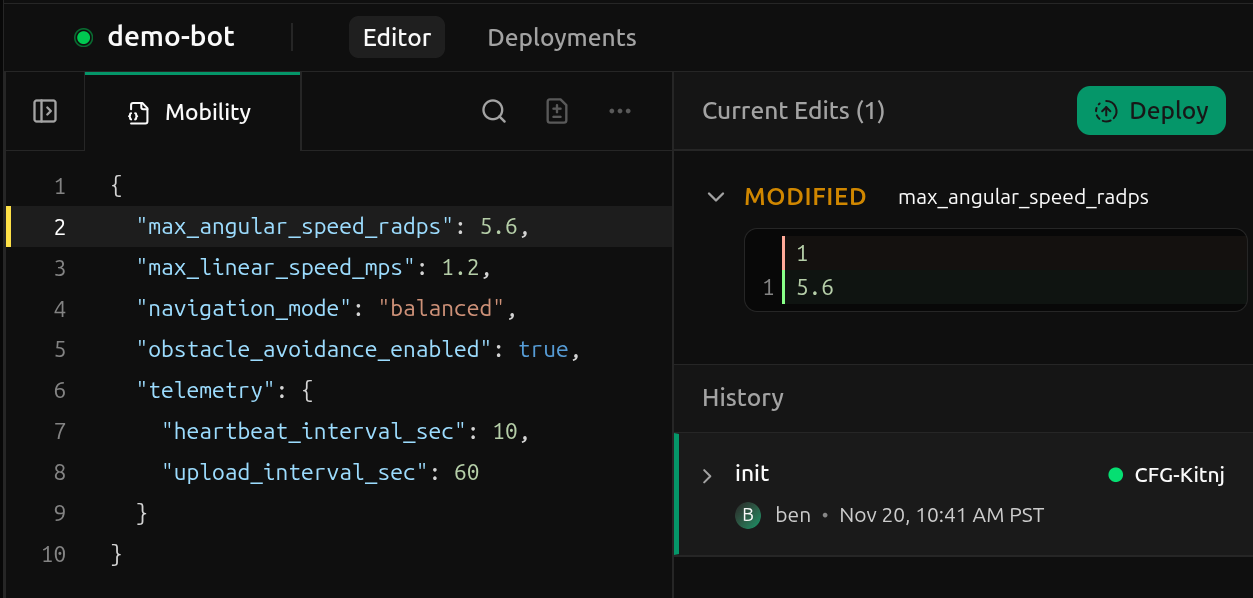
Most of these constraints are optional, and many features of JSON Schema are omitted here, but this gives you a flavor of what schemas are capable of. Say we are deploying the following config instance.
Unbeknownst to us, the max_angular_speed_radps field exceeds the maximum allowed value of 3.0. Luckily, before deployment to the device, the config instance is validated against the schema, throwing the following error:

Identifying the issue, we correct the max_angular_speed_radps field to use the maximum allowed value of 3.0 and deploy the config instance to the device.
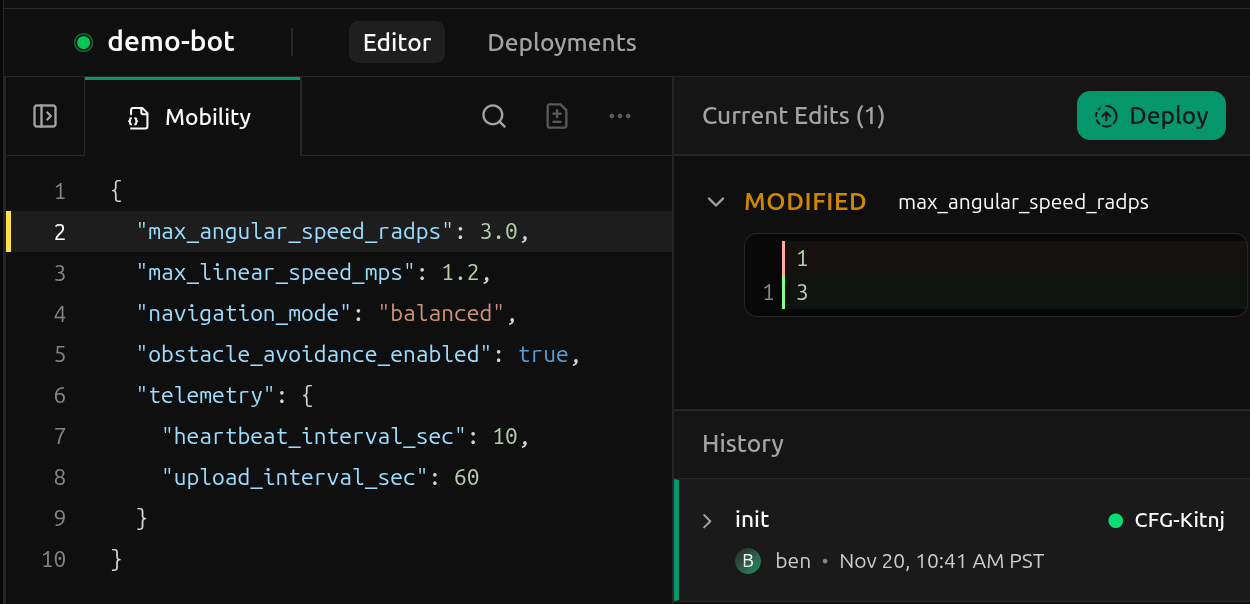
This time, the config instance successfully validates against the schema and is deployed to the device. Although simple in concept, schemas are a powerful tool for preventing typos, misconfigurations, and other preventable errors.

Empty schemas

While schemas provide significant value in production deployments, defining one from scratch can be a considerable undertaking. Many teams find it best to begin with an empty schema—one that accepts any configuration—and gradually add constraints. This approach allows you to define the most highly valued constraints first and progressively transition to stricter and stricter schemas as needed. Below are the empty schemas for JSON Schema and CUE, respectively.
$schema: "https://json-schema.org/draft/2020-12/schema"